On this page
Start a judo video review
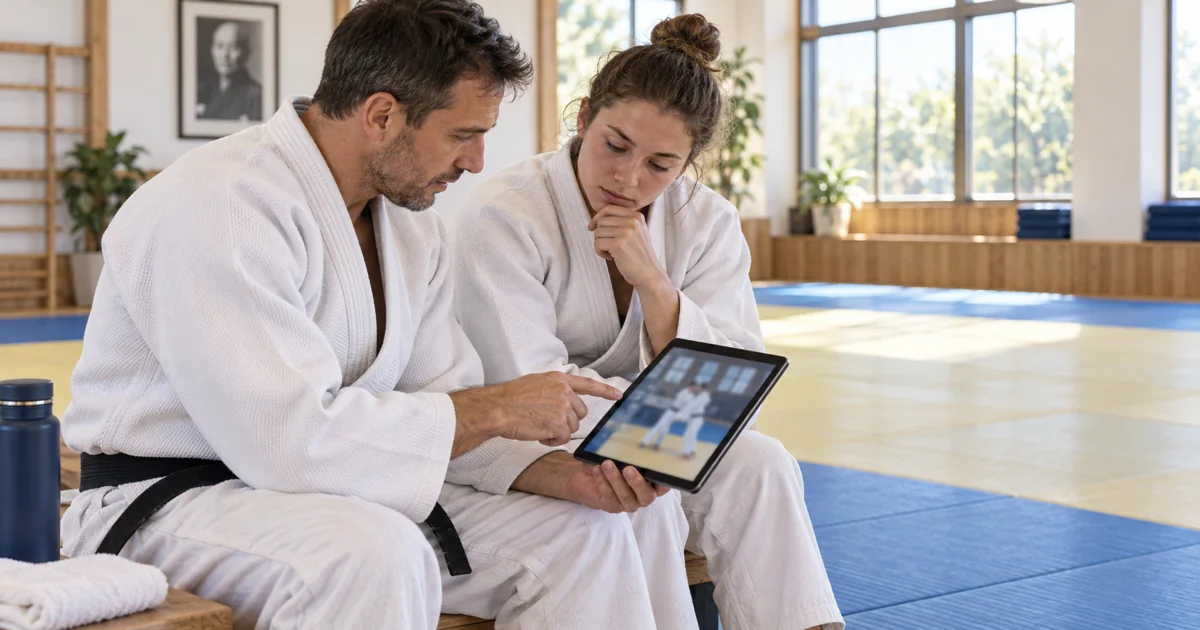
Use a judo video analysis app to organise a question about an exchange, not to extract a correction automatically. Choose footage that shows the relevant beginning, the action and what followed. Write the assigned exercise or match context beside it, then note a visible event and what you want to understand. You can do this first on paper with the linked review checklist. Keep the original recording so an unclear lead-up can be checked. Select any digital tool by its documented features, and take the question to your coach before changing practice.
Judo Match Video Review Checklist
Copy or print a judo match-video review sheet. Separate visible actions, hidden details and questions for your coach, one exchange at a time.
Open templateSeparate observation from explanation
The end of a throw can hide the question you need to ask. If the sleeve is already out of view when a turn begins, the landing cannot tell you exactly when contact changed. Review the lead-up rather than completing the missing movement in your imagination. Put visible actions, your remembered experience and possible explanations on separate lines. A note such as “I felt rushed” is useful as a report, not a measured cause. Include a successful exchange under comparable instructions to explore what was different, without assuming its technique is the answer.
Find the relevant moment
Start by naming the question in ordinary words: “What happened before I stopped entering?” Watch at normal speed to locate the exchange, then revisit the relevant moment if your player allows it. Note the starting arrangement, which hands or feet are visible and what the partner does before your action. Use a timestamp to find the moment again; no fixed clip length fits every question. If the key detail is hidden, record that limitation or look at another permitted view. End with the observation you can support and the question that remains.
Choose paper or digital support
Before uploading anywhere, check permission to record and share, the dojo’s rules and the service’s current handling of videos. Permission to film does not automatically mean permission to upload to a third party. Keep private partner details out of shared notes. The linked worksheet is a copyable or printable aid, not an upload form; paper is enough to prepare a coaching discussion. If you want Judo AI support, consult its feature guide and privacy information. Keep an AI interpretation separate from visible evidence and feedback your coach actually gave.
A fictional comparison of two entries
Consider a fictional comparison of two familiar entry attempts in an assigned exercise. In A, the partner steps back before your rotation and the entry stops. In B, the assigned entry is completed, but one foot is outside the frame. Write those observations rather than “the backward step caused failure” or “copy B”. A useful question is: “Are the starting conditions comparable, and what should we inspect before the turn?” In this example the coach asks to see the earlier grip exchange. Record that reply, leaving a new task undecided until discussed.
Revisit the question after practice
At the agreed later review, return to the timestamp and the question, not just the final outcome. Record whether the relevant situation occurred in the practice you actually did, which instruction was given and whether the view makes the same detail visible. A changed partner or camera angle may limit comparison. Keep successful observations and unresolved details; an unattempted task is not evidence that the suggestion failed. Recognising something after a reminder also differs from recognising it later without that reminder. Use the record to decide with your coach what still needs checking.
Annotate an event before explaining it
Make three columns on paper: visible event, personal report and question. In a fictional annotation, the event reads “the sleeve leaves the frame before the turn”; the report reads “I remember losing my grip”; the question reads “can another view establish when contact changed?” The first line describes the image, while the second preserves a memory. Neither line should silently replace the other when you share the note.
Add the timestamp and identify the view used. If another permitted view shows the hand, add its observation as a new line rather than rewriting the earlier uncertainty as something you always knew. Ask what information would change the explanation. A diagram can help locate the visible hands, but label any reconstructed position as a sketch or hypothesis, not a measurement from the recording.
Decide what two recordings can fairly compare
Place a short context line above each recording: assigned task, starting grip or position, partner role, practice or match, and useful viewing limits. In a cooperative entry exercise the partner may be providing the demonstrated response; in randori they may choose another action. An entry completed in the first context and stopped in the second answers different questions. Keep both records, but do not combine them into a single success rate.
Choose a comparison because it helps answer the question, not because the outcomes look dramatic. Note whether the same start is visible and whether the instruction changed. Your own report of tiredness may also matter, but the camera does not establish its contribution. If the clips cannot answer the original question, preserve that conclusion and ask which existing observation would be more useful.
Check the tool against your actual review task
Before choosing a tool, list the actions you need: find a timestamp again, replay a relevant interval, place a note beside the clip and retrieve it later. Check whether the current product documentation describes those actions, any file or language limits and how notes can be retained. An attractive demonstration does not show that every feature is available on your device or in the version you are considering.
If the tool generates an interpretation, check whether you can return to the underlying moment and distinguish its text from your own note. Review the current privacy and deletion information before providing footage; a local paper note may be sufficient. Prefer a workflow you can actually revisit over collecting more outputs. No score or fluent explanation substitutes for checking whether the described action is visible.
Make the coaching discussion easy to answer
Bring the question, its timestamp and enough context to explain the assigned exercise. You might say, “I can see my partner turn, but I cannot see my sleeve hand; which part should we check first?” A question tied to a moment lets the coach ask for the earlier sequence, clarify the task or explain that the footage cannot resolve it. You do not need to begin with an accusation about your partner or yourself.
Write the reply beside the question, using quotation marks only for words you can accurately retain. Keep a paraphrase labelled as your summary. If no new practice task is agreed, leave that field open. The useful outcome may be understanding a successful exchange or recognising a viewing limit. Ask when to return to the question within coaching opportunities, without turning the discussion into extra assigned workload.
Review learning without manufacturing a progress score
A note can distinguish situations: the task was not attempted, the relevant opportunity did not occur, the opportunity occurred but you did not recognise it, or you recognised it and acted. Use only the distinctions you can support from the recording and your own report. If the coach reminded you just before the action, record that help rather than comparing it silently with an attempt made without a reminder.
Keep the question meaningful when a partner or task changes. A different response can reveal another situation to discuss, but it does not by itself prove transfer or loss of learning. Record a success with its conditions, and leave uncertain attempts uncertain. At the agreed review, decide whether the explanation still fits, needs revision or cannot yet be judged. A review may end with a better question rather than another drill.